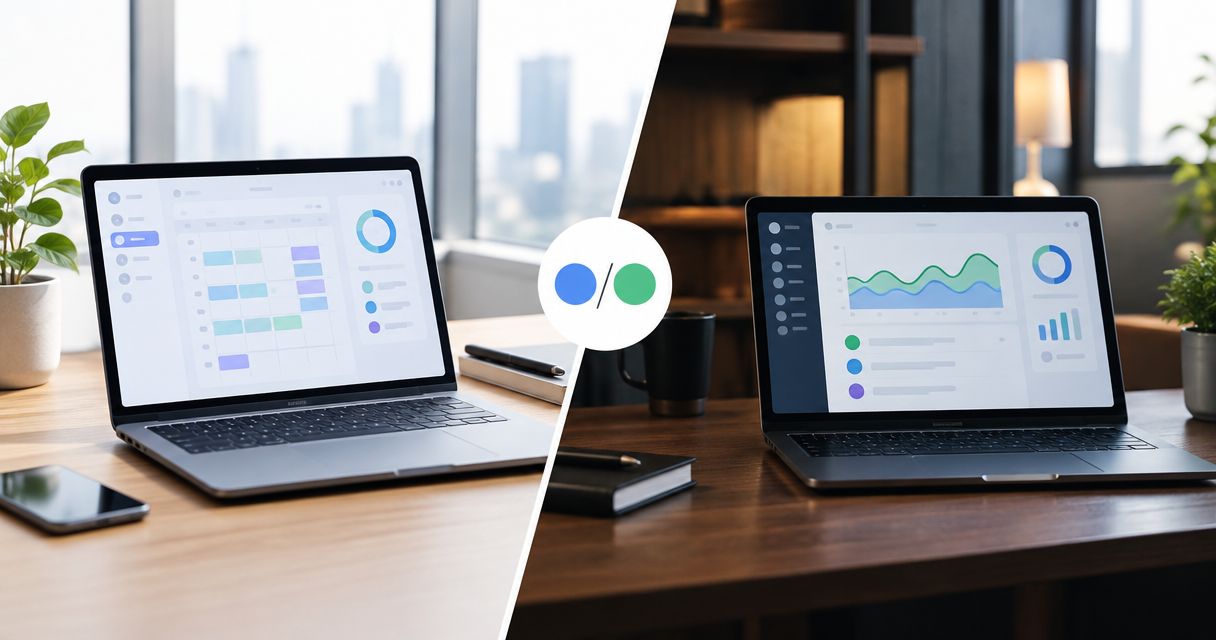
Choose Kloqk if your 2026 priority is a free employee time clock tied to U.S. overtime rules and payroll exports; choose Jibble if you need GPS-based field visibility and project time tracking. Kloqk is the better fit for a U.S. small business that needs clock-ins, overtime review, and payroll handoff in one platform; Jibble is the better fit for teams organizing time by location and project.
- Kloqk vs Jibble: choose Kloqk for U.S. overtime rules and one-click payroll exports.
- Choose Jibble when GPS location data and project time tracking drive your attendance workflow.
- Both support mobile and kiosk clock-ins; compare the identity checks and reports your team will use.
- For California staff, test daily and weekly overtime with your own schedules before choosing a system.
Why this matters
A clock-in is only the start of a pay record. Someone must confirm who worked, review the hours under the right overtime rules, and move approved time into payroll. If employees move between job sites, you also need to know where they clocked in and which project received the time.
Those needs point to different tools in 2026. A restaurant manager reviewing shared-kiosk punches and California overtime has a different decision from a construction manager assigning hours to jobs across multiple sites. The strongest choice is the one that removes the most manual work from your review process—not the one with the longest feature list.
At a glance
| Dimension | Kloqk | Jibble |
|---|---|---|
| Best for | U.S. small and mid-size teams focused on attendance, overtime, HR, and payroll handoff | Teams focused on location-aware attendance and project time |
| Clock-in methods | Kiosk PIN and mobile punch | Mobile and kiosk clock-ins |
| Identity checks | Photo verification | Facial recognition |
| Overtime | FLSA and California overtime support | Time records to review against applicable rules |
| Payroll handoff | One-click payroll exports | Timesheet exports |
| Field visibility | Mobile punches | GPS-based location tracking |
| Project time | Attendance-first workflow | Project time tracking |
| HR scope | Employee time clock and HR platform | Time and attendance with project tracking |
| Pricing model | Free platform | Free option and paid plans |
| Standout feature | U.S. overtime support alongside payroll exports | GPS and project-based time records |
The table shows the decision axis, not a claim that either product lacks every feature shown in the other column. Check the exact workflow you intend to use, including any plan limits, before moving a live payroll process.
Kloqk fits a U.S. payroll-first team; Jibble fits a field-first team
Best for payroll-first operations: Kloqk. Its stated scope joins employee clock-ins, photo verification, FLSA and California overtime support, HR, and one-click payroll exports. That combination suits a manager whose main question is whether approved attendance can become payroll-ready time without rebuilding the record in another system.
Best for location- and project-first operations: Jibble. GPS information helps you review where a field punch happened, while project time tracking helps allocate recorded work. Those are distinct questions from whether a timesheet reflects the overtime rules that apply to a U.S. employee.
Write down which decision happens most often in your business: approving pay, confirming a work location, or assigning labor to a project. If two of those matter equally, test both vendors against the same real shift instead of deciding from a feature label.
Both handle mobile and kiosk clock-ins
For clock-in methods, this is a tie. Both offer a way for employees to punch on a mobile device and at a shared kiosk. The meaningful difference is what a manager needs to inspect after the punch, not whether the punch can happen.
A shared device makes sense when staff arrive at one workplace. A mobile punch makes sense when they begin work away from that device. If your team does both, walk through a full shift: start on a kiosk, take the breaks your policy requires, finish on mobile, then check the resulting record. Confirm how each product presents corrections before relying on it for payroll.
Do not treat a punch method as an attendance policy. You still need to decide who approves edits, how missed punches get corrected, and what evidence managers review when a record is disputed. Those choices matter in 2026 whether the initial punch comes from a phone or a kiosk.
Photo verification and facial recognition solve different checks
Choose the identity method your workplace will actually use. Kloqk provides photo verification. Jibble offers facial recognition. Both address the risk of someone clocking in for another employee, but a captured photo and an automated face check are different review workflows.
If a manager wants an image alongside a punch for manual review, photo verification matches that task. If automated face matching is central to the process, Jibble has the clearer feature match. Neither approach replaces a rule for correcting an honest mistake or reviewing an employee’s disputed time.
Test identity checks with the conditions your staff face: a busy shared entrance, mobile punches away from a manager, and a missed punch at the end of a shift. Ask who can see the verification record and what happens when a check fails. A feature that slows down every clock-in can create a new attendance problem while addressing buddy punching.
Kloqk has the clearer U.S. overtime fit
Kloqk wins when FLSA and California overtime are part of the buying brief. Those rules are explicit in its stated platform scope. That does not make any time clock a substitute for reviewing worker classification, pay rules, or corrected punches; it makes the relevant overtime workflow a direct selection criterion.
For covered, nonexempt employees, the federal Fair Labor Standards Act generally requires overtime pay after 40 hours in a workweek at no less than 1.5 times the regular rate of pay. California also has daily overtime rules: generally 1.5 times the regular rate after 8 hours in a workday and 2 times after 12 hours, subject to applicable exceptions. Daily and weekly overtime require careful review so the same hours are not counted twice.
Use one ordinary week and one week that crosses a daily overtime threshold when you evaluate a system in 2026. Check the recorded punches, the workday and workweek boundaries, any edits, and the totals sent to payroll. If your workforce spans states, do not apply one location’s rules to everyone simply because they share a timesheet.
Kloqk offers the more direct payroll-export workflow
Kloqk wins on the stated handoff: it provides one-click payroll exports. Jibble provides timesheet exports, so both can get time data out of the attendance system. The practical question is what arrives in the file and how much a payroll administrator must fix before using it.
Take a sample pay period through both products. Include a corrected punch, a break, and an overtime shift. Then compare the exported fields with what your payroll process requires. An export is not the same thing as a verified connection to a particular payroll provider; confirm any required integration separately rather than assuming it from the word export.
For a small business, the best report is not necessarily the one with the most columns. It is the one a manager can review and a payroll administrator can use without guessing which hours were approved. Make the approval step visible before you decide that either handoff is finished.
Jibble is the better fit for location-aware field work
Jibble wins when a manager needs GPS context for employee punches. Location information can help answer whether a punch happened at the expected work site. It does not, by itself, establish that every minute between punches was worked or that the employee was assigned to the right job.
A mobile punch and a location-aware punch serve different purposes. If your field team only needs to submit time away from a shared kiosk, mobile clock-in is the requirement. If a supervisor must review where a punch was made, put GPS behavior in the trial checklist: examine the record a manager sees, how an inaccurate location is handled, and what happens when an employee contests it.
This is a stronger reason to choose Jibble than simply having staff who travel. Define the decision the location record must support before making it a requirement for every worker.
Jibble is the better tool for project time allocation
Jibble wins when time must be assigned to projects as well as employees. Its project tracking addresses a different reporting question from basic attendance: not just who worked and for how long, but which project received the time.
That distinction matters when a worker changes tasks during a shift. A start and end punch gives you a span of recorded time; project tracking gives you a way to divide work across jobs. Before committing to either workflow, check how employees enter project changes and how a manager corrects an assignment without changing the underlying attendance record.
Do not add project selection to every punch unless someone will use the resulting report. For a salon or retail store focused on accurate pay, extra job coding can add work without improving payroll approval. For a team that reviews labor by project, leaving those assignments in a separate spreadsheet creates a different kind of work.
Kloqk offers a broader stated HR scope
Kloqk wins if you want the time clock inside an HR platform. The platform is described as both an employee time clock and an HR platform. Jibble’s clearer comparison strengths here are attendance, location, and project time.
Do not turn that distinction into an assumed feature checklist. An HR platform label does not establish which employee records, approvals, or documents your business needs, and a time-tracking label does not prove a vendor lacks them. List the specific HR tasks you want alongside attendance, then ask each vendor to show those tasks in the product.
For a U.S. small business in 2026, keep the buying test narrow: can a manager maintain the employee information needed for the clock-in and payroll workflow without duplicating routine updates? If the answer depends on a separate system, account for that work when comparing the two options.
Pricing: compare the workflow, not just the entry point
Kloqk is described as a free employee time clock and HR platform. Jibble offers a free option alongside paid plans. That is the pricing-model difference to examine; do not assume that a feature you saw on a vendor page is included in the option you intend to use.
Write down the functions your team needs before checking current plan terms: kiosk access, mobile punches, identity checks, overtime review, project tracking, location data, and exports. Ask each vendor which of those functions is available in the setup you would choose. The lowest-friction option is the one that supports the complete pay-period workflow your team will run in 2026.
Check the time clock workflow
Review kiosk PIN, mobile punch, overtime support, and payroll exports.
The standout feature depends on the record you need
Kloqk’s standout combination is U.S. overtime support with one-click payroll exports. It is useful when attendance records must pass through rule review before a payroll handoff. The limitation in this comparison is equally clear: the provided platform description does not establish GPS or project allocation as its strengths.
Jibble’s standout combination is GPS context with project time tracking. It is useful when a manager needs to review both where a field punch occurred and where work time belongs. Its strength does not remove the need to test your specific U.S. overtime and payroll-review process before adoption.
Final verdict: choose the workflow you review every pay period
Choose Kloqk if you run a U.S. restaurant, retailer, salon, clinic, or similar team and your main job is turning verified punches into reviewed overtime and payroll-ready exports. It is the clearer match for a payroll-focused manager who also wants the clock inside an HR platform.
Choose Jibble if you manage a field team that needs GPS-aware punches and project-based time records. It is the clearer match when location and job allocation are the questions a supervisor must answer each day.
Use this 2026 scorecard to keep the final decision tied to a specific task:
| Dimension | Winner |
|---|---|
| Payroll-first U.S. team | Kloqk |
| Field- and project-first team | Jibble |
| Mobile and kiosk clock-ins | Tie |
| Photo review | Kloqk |
| Facial recognition | Jibble |
| Stated FLSA and California overtime support | Kloqk |
| One-click payroll exports | Kloqk |
| GPS-based field visibility | Jibble |
| Project time allocation | Jibble |
| Stated HR platform scope | Kloqk |
| Pricing model | Compare required features in each option |
FAQ
Is Kloqk or Jibble better for a U.S. small business in 2026?
Kloqk is the better fit when U.S. overtime review and payroll exports drive the decision; Jibble is the better fit when GPS and project time are central. Test both against a real pay period before changing your process.
Can employees clock in on mobile with both Kloqk and Jibble?
Yes, both provide mobile clock-ins. Both also support a kiosk workflow, so compare the resulting records and correction process rather than choosing on punch method alone.
Which is better for California overtime?
Kloqk has the clearer stated fit because its platform description includes California overtime compliance. Check your workday settings, recorded hours, edits, and payroll totals with an actual California schedule.
Does Jibble support project time tracking?
Yes, Jibble supports project time tracking. Use it when you need to assign employee hours to jobs as well as record attendance.
How do the identity checks differ?
Kloqk provides photo verification, while Jibble offers facial recognition. Choose based on whether your managers need a photo to review or an automated face check, and test how exceptions are handled.
Does a payroll export mean direct payroll integration?
No, an export and a direct integration are different workflows. Confirm the file fields and any required connection with your payroll provider before selecting either tool.
Is Kloqk or Jibble better for construction crews?
Jibble is the stronger fit when crews need GPS context and project time allocation. Kloqk is the stronger fit when the priority is U.S. overtime review and payroll exports; test both needs if your crew requires both.
One last thing
Run the same edited shift through each system before you decide. A clean clock-in rarely exposes the work your manager does later; a missed punch, an overtime day, and a payroll export will. That short test makes the Kloqk vs Jibble decision about the record you can actually approve, not the feature list you can read.